

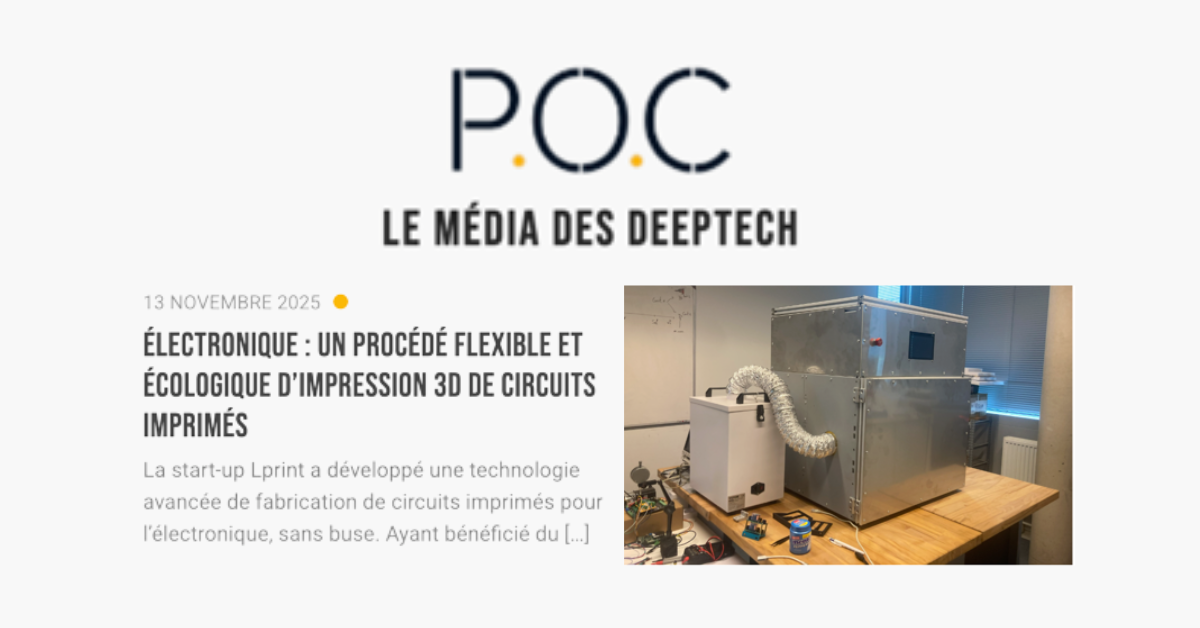
Recently, POC Media published an in-depth interview with Lprint about our technology for 3D printing electronic circuits. The article explores how additive manufacturing can address some of the structural limitations of traditional PCB production, particularly in terms of flexibility, speed, and environmental impact.
In the interview, we explain that conventional PCB manufacturing is primarily optimized for large-scale production, which makes it less suitable for rapid iteration and small series. As Artem Perov, co-founder of Lprint, explains:
“Traditional PCB manufacturing remains focused on large-scale industrial production. Our additive technology makes it possible to move beyond these limitations, as it is better suited to prototyping and to the production of small and medium batches of customized and complex circuits.”
Beyond improvements in speed and flexibility, the interview highlights the new possibilities enabled by Lprint’s technology. Printing circuits layer by layer allows for freer geometries, easier adaptation to mechanical constraints, and new levels of miniaturization. It also opens the door to integrating passive components—such as resistors, coils, antennas, or capacitors—directly into the printed circuit, reducing assembly steps and enabling more compact electronic systems.
The interview also addresses the environmental impact of electronics manufacturing. While traditional PCB fabrication relies on subtractive processes involving large amounts of water, chemicals, and raw materials, Lprint’s approach significantly reduces these requirements. Artem Perov notes:
“Our machine makes it possible to reduce the environmental footprint of PCB manufacturing by decreasing water consumption by 98% and raw material usage—especially copper—by 75%. In addition, the process halves energy consumption and reduces CO₂ emissions by 85%.”
Overall, the interview presents Lprint’s technology as an alternative approach that not only improves existing workflows but also enables new design and production scenarios for electronic systems.
We thank POC Media for the interview and for providing a space to share our technology, vision, and next steps with the deeptech community.